Geometry Dash Wave Tips – Master the Hardest Mode (2.2 Era)
Learn how Wave really works in Geometry Dash 2.2. Master mini wave, controlled spam, overcorrection fixes, and the best practice levels to improve faster.
Wave is the mode that makes many Geometry Dash players feel like they suddenly forgot how to play. Your icon is tiny, the corridors are brutal, and one bad correction can send you straight into a wall.
That is exactly why Wave matters so much. It exposes panic inputs, bad visual habits, and weak timing faster than almost any other mode. If your Wave control improves, your overall Geometry Dash consistency usually improves with it.
This guide breaks Wave down the smart way for 2026. You will learn how Wave actually works, why overcorrecting keeps killing you, how mini wave and controlled spam differ from normal Wave play, and which levels to practice in order if you want real progress.
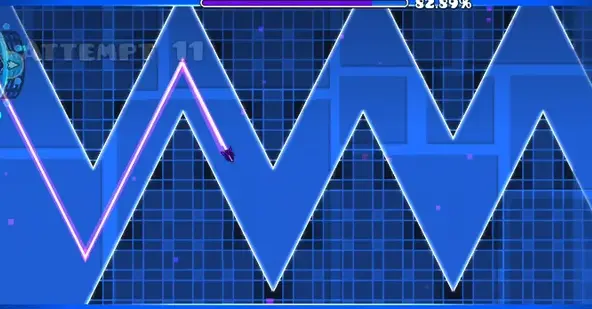
Why Wave Feels So Hard
Wave is difficult because it gives you almost no room to hide sloppy control. Cube can sometimes survive a late jump. Ship can sometimes recover from a rough line. Wave usually cannot. The mode turns every bad read, every panic hold, and every late correction into a crash.
- The movement changes direction instantly, so your mistakes are visible immediately.
- Tight gaps force you to control both height and rhythm, not just one or the other.
- Mini wave is much more sensitive than normal wave, so overholding becomes lethal.
- Many hard Wave sections stack speed changes, gravity changes, and visual clutter at the same time.
How Wave Actually Works
Hold to rise, release to fall
Wave movement is simple at the surface. When you hold, the icon rises diagonally. When you release, it falls diagonally. The challenge comes from how quickly the direction changes and how little space hard levels give you to stabilize.
Why speed changes make the angle look different
The vertical behavior of Wave stays consistent, but the horizontal speed of the level changes how the line looks on screen. At faster game speeds, the path looks flatter. At slower speeds, it looks steeper. This is one reason players feel 'off' after speed portals even when the core input logic is still the same.
Normal Wave vs Mini Wave
Normal Wave gives you more room to feel the rhythm of longer holds and releases. Mini wave is far more sensitive. Small inputs create much bigger positional changes, which is why new players often use normal-wave force on mini wave and die instantly. Mini wave is less about confidence and more about very light micro-taps.
Spam vs Controlled Spam
Spam is not just clicking fast. Bad spam is random panic tapping that only works in wide sections. Controlled spam is different: you match your click rhythm to the width of the space, keep your line stable, and avoid wasting motion. High-level Wave play is usually more about control than raw CPS.

The Biggest Wave Mistakes
- Overcorrecting after a small drift instead of using shorter, earlier fixes.
- Treating mini wave like normal wave and holding much too hard.
- Trying to react to the current obstacle instead of reading the next one.
- Turning every spam section into a panic mash instead of a controlled rhythm.
- Keeping the same visual focus after speed portals, camera tricks, or gravity changes.
Why you keep overcorrecting
Most overcorrection starts because you react after the Wave has already drifted too far. Then you hold longer than necessary to fix it, which launches you into the opposite wall. Good Wave players do not wait for the icon to get lost. They make earlier, smaller adjustments before the mistake becomes large.
Why tight gaps fall apart at speed
In tight gaps, your input window is tiny. Once the level speeds up, heavy clicks become a problem because they last longer than you think. A section that looks possible in theory becomes impossible in practice if every correction is too strong. Fast Wave is usually lost through overforce, not underforce.
Why mini wave feels fine in practice but collapses in real runs
Mini wave often appears after another mode or after normal Wave. In practice mode, you may enter it calmly and in isolation. In a real run, you arrive with leftover rhythm, leftover tension, and the wrong input strength. That transition gap is why many players say they 'know the part' but still die there.
Why spam fails under pressure
When pressure rises, players stop following a stable pattern and start forcing clicks. The result is messy CPS, random gaps in rhythm, and a line that becomes impossible to hold. If your spam always collapses near the end of a run, the problem is usually loss of control, not lack of speed.
How to Practice Wave the Smart Way
Keep sessions short and focused
For most players, 30 to 45 minutes of focused Wave practice is enough before quality starts dropping. Once your hand gets tense and your timing turns angry, you stop building clean muscle memory and start reinforcing mistakes.
Reverse practicing works better than grinding from 0%
Do not only grind full attempts. Put a start position near the end, stabilize the last section first, then move backward. If you practice 80% to 100%, then 60% to 80%, then connect them, your late-run consistency improves much faster and your choke rate drops.
Train one Wave skill at a time
- One session: mini wave control and light micro-taps.
- Next session: tight gaps and small corrections.
- Another session: controlled spam and straight-line rhythm.
- Separate session: gravity switching and upside-down Wave reading.
Know when to switch levels
If you are stuck on the same section for multiple days and no longer feel any improvement, switch to a similar level that trains the same skill. Sometimes your hands do not need more force. They need a different angle on the same problem.
Best Wave Levels to Practice in Order
A good Wave training route should teach one thing at a time. Start with easier challenges that build basic rhythm, then move into gravity changes, mini wave, tight gaps, controlled spam, and finally mixed advanced sections.
Easy
- Childlike: A good first step if you are brand new to Wave and need simple rhythm practice.
- SMY Challenge: Another beginner-friendly entry point that helps you get comfortable with the basic diagonal control pattern.
Normal
- Happy Purple: Good for building basic Wave consistency before the harder skills arrive.
- Wave Thing: Excellent for learning gravity switching, upside-down Wave, and staying calm when the line direction changes.
Hard
- go by Mark: Great for learning mini wave without jumping straight into impossible corridors.
- Robber Spike: Useful for click-rate control and teaching you that harder Wave sections often require rhythm, not panic.
Harder
- On My Way: Strong for normal Wave and mini wave tight-gap control.
- Path: Excellent for slow, precise Wave play where every overcorrection gets punished.
Insane
- Solair: A fast, flow-based Wave challenge with tighter gaps and more advanced reading demands.
- Flood Warning: Great for slow precision mixed with gravity switching, which makes it one of the best transition trainers on this list.
Demon
- Better Crocker: Very good for controlled spam. It teaches you to manage spam rhythm instead of just clicking wildly.
- dun: A true late-stage Wave challenge with fast gameplay, tight gaps, mixed normal and mini wave control, and awkward click patterns that expose weak habits.

2.2 Era Problems That Make Wave Harder
- Camera controls: Zooms, offsets, and static camera tricks can ruin your normal sense of where the Wave sits on screen.
- Reverse gameplay: Flying left forces a mirrored version of your normal reading habits and feels far stranger than it looks.
- Visual interference: Heavy effects, filters, and clutter make reading the corridor itself part of the challenge.
In the 2.2 era, Wave is not only a control test. It is also a reading test. Many hard sections are difficult because the game is attacking your visual assumptions, not just your click timing.
Fast Fixes for Common Wave Problems
If you always overcorrect
- Move your eyes farther right instead of staring at your icon.
- Use smaller, earlier corrections instead of long panic holds.
- Practice slower precision levels until short taps feel normal.
If mini wave feels impossible
- Treat mini wave like a lighter input problem, not a faster normal wave.
- Isolate mini wave sections instead of always reaching them from full runs.
- Think 'touch the button' instead of 'press the button.'
If straight fly or spam feels random
- Stop chasing max CPS and focus on even rhythm first.
- Try to make your press and release time feel more balanced.
- Practice in short bursts so your hand stays loose instead of stiff.
Final Advice: Wave Gets Easier When It Stops Feeling Personal
Wave improvement usually looks messy before it looks clean. You die in the same gap, then the same transition, then the same spam. That does not mean you are hopeless. It means the game is showing you exactly which skill needs work.
The fastest way to get better is not to panic harder. It is to reduce the problem: one kind of gap, one kind of spam, one kind of transition, one clean habit at a time.
FAQ
How do I get better at Wave in Geometry Dash?
Focus on one Wave skill at a time. Practice mini wave, tight gaps, gravity switching, and controlled spam separately instead of trying to improve everything at once.
Why do I keep overcorrecting in Wave sections?
Most players correct too late and hold too long. The fix is to look farther ahead, make smaller earlier adjustments, and stop trying to rescue the line after it has already drifted too far.
How do I practice mini wave properly?
Treat mini wave like a light-input problem. Use micro-taps instead of normal-wave force, isolate mini sections in practice mode, and avoid reaching them only through full runs.
What is the difference between spam and controlled spam in Geometry Dash?
Spam is random panic clicking. Controlled spam is when your click rhythm matches the width of the space and keeps the line stable. High-level Wave play depends much more on controlled rhythm than on raw clicking speed.
What are the best levels to practice Wave in Geometry Dash?
A strong Wave training route starts with easier rhythm challenges, then moves into gravity switching, mini wave, tight gaps, precision, and controlled spam. Levels like go by Mark, Path, Flood Warning, and Better Crocker are useful because each trains a different part of Wave control.
Why does mini wave feel easy in practice but fail in real runs?
Because real runs usually bring leftover rhythm, tension, and transition pressure from earlier sections. In practice mode you often enter mini wave in isolation, which feels much calmer and more controlled.
How long should I practice Wave each day?
For most players, 30 to 45 minutes of focused Wave practice is enough before quality starts dropping. Once your hand gets tense, you often start reinforcing bad habits instead of building clean control.
Does Geometry Dash 2.2 make Wave harder?
In some ways, yes. Camera tricks, reverse gameplay, and heavier visual interference make Wave more of a reading challenge than before, even when the underlying control logic stays familiar.