Official Geometry Dash Levels in Order – Best Beginner Path
Learn the best beginner path through Geometry Dash official levels. Find out what each level teaches, when to use Practice Mode, and which levels to delay before demons.
A lot of players assume the official Geometry Dash level order is automatically the best learning path. It is not. The in-game order is fine as a rough progression, but it hides an important truth: some levels teach core skills, some levels test them brutally, and some levels can wreck your confidence if you touch them too early.
That is why this guide does not just repeat the level list. It explains the smartest beginner path through the official levels, what each stage is really teaching you, where the first serious skill walls appear, and when you are actually ready to challenge the demon gates.
If you are new to Geometry Dash, the goal is not to rush the hardest official levels. The goal is to build timing, rhythm, visual reading, mode control, and consistency in the right order so the hard stuff stops feeling random.
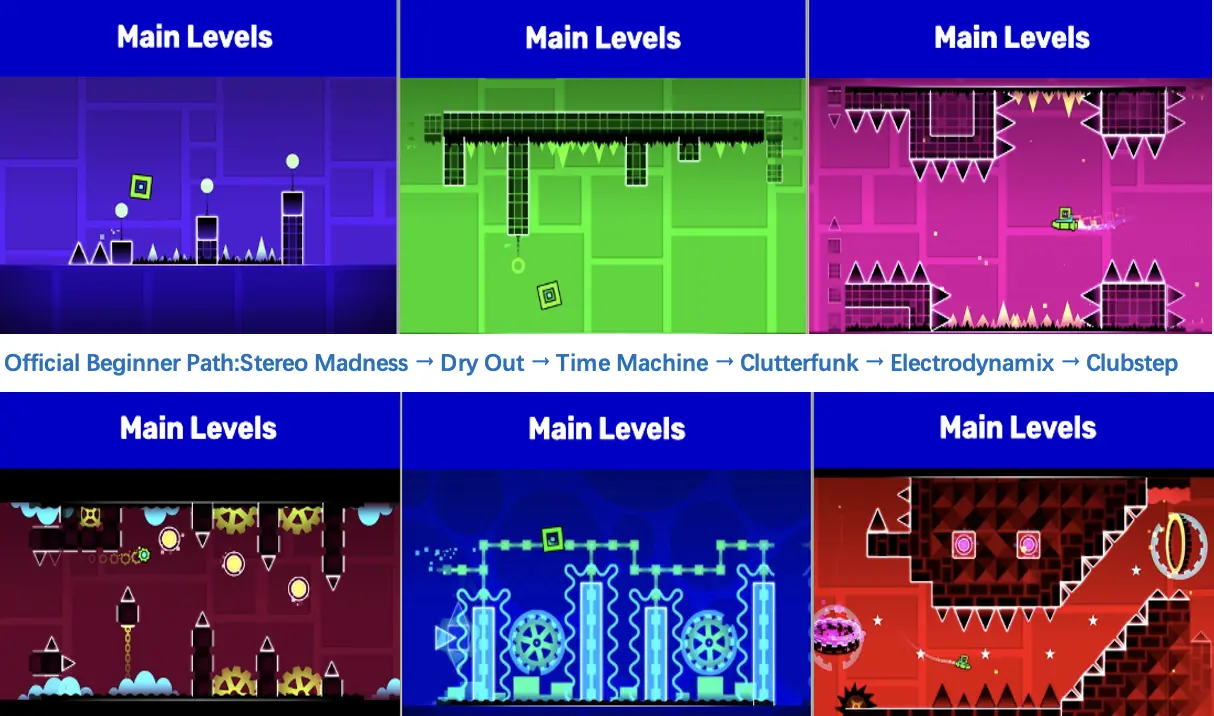
Why Official Levels Still Matter
Official levels are still the best structured tutorial path in Geometry Dash. They introduce movement modes, gravity changes, fakeouts, speed pressure, and demon-style execution one layer at a time. Even in the 2.2 era, they remain the cleanest way to build real fundamentals before you get lost in random community levels.
- The early levels build raw timing and rhythm confidence.
- The middle levels teach pattern reading, memory, and mode switching.
- The later official levels prepare you for real Demon gameplay better than many flashy custom levels do.
- Because the levels are widely known, they also give you a common skill benchmark for judging your progress.
The Best Beginner Path by Stage
The official levels make much more sense when you group them by what they teach instead of looking only at stars and unlock order.
Tier 1: The Basics
- Stereo Madness
- Back on Track
- Polargeist
This is the pure beginner phase. These levels teach basic jump timing, basic pads and orbs, and the feeling of auto-scrolling rhythm without heavy visual tricks. Nothing here is trying to fool your brain yet. The point is to stop feeling lost and start feeling in sync.
Tier 2: Gravity and Spatial Awareness
- Dry Out
- Base After Base
- Can't Let Go
This stage introduces upside-down logic and the first real moments where your eyes stop being enough by themselves. Dry Out forces you to accept reversed gravity. Base After Base asks for more rhythm stability. Can't Let Go starts to pressure your spatial awareness and your ability to keep moving when visual comfort disappears.
Tier 3: Memory and Consistency
- Jumper
- Time Machine
- Cycles
This is where the game starts punishing players who are still relying only on reaction. Mirror effects, triple spikes, and repeated gravity changes force you to build actual consistency. You are no longer just seeing and jumping. You are learning sections.
Tier 4: Complex Mechanics
- xStep
- Clutterfunk
- Theory of Everything
- Electroman Adventures
This section turns up the real gameplay pressure. UFO, mini mode, and denser transitions start showing up more aggressively. Clutterfunk is the monster here. If the early game taught you confidence, this phase teaches you discipline.
Tier 5: Speed and Asymmetry
- Electrodynamix
- Hexagon Force
- Blast Processing
- Geometrical Dominator
Now the game starts asking for real reading skill under pressure. Electrodynamix compresses your reaction time with brutal speed. Hexagon Force introduces asymmetrical dual gameplay. Blast Processing and Geometrical Dominator expand your familiarity with modern-feeling mode pressure, including Wave and stronger visual rhythm demands.
Tier 6: The Demon Gates
- Clubstep
- Theory of Everything 2
- Deadlocked
This is the official demon benchmark. Tight Ship control, memory traps, fake paths, Wave execution, and pressure all combine here. These are not good 'casual test' levels. They are exams.
Tier 7: The Modern Showcase
- Fingerdash
- Dash
These levels feel more like a preview of Geometry Dash's later design language. Spider, camera tricks, modern visual movement, and Swing make them valuable, but they should be understood as showcase levels, not the main path that teaches old-school fundamentals.
What the Key Official Levels Actually Teach You
Stereo Madness
This level teaches the raw basics: jump timing, rhythm trust, and the first feel of Ship rise-and-fall inertia.
Dry Out
Dry Out is where many new players first feel their brain flip. Its real lesson is upside-down control. It teaches you that Geometry Dash is not only about pressing at the right time, but about adapting to reversed logic without panicking.
Can't Let Go
This level trains rhythm trust under visual discomfort. The darker late sections pressure you to stop depending on clean visual reference alone and start syncing more naturally with the level's flow.
Jumper
Jumper starts demanding cleaner consistency between segments. Instead of isolated jumps, you need to keep your timing stable through connected gameplay and mode transitions.
Time Machine
This is the triple-spike wall. Time Machine is a psychological test disguised as a level. It punishes hesitation, overthinking, and irregular jump rhythm more brutally than most early levels.
Cycles
Cycles is the real Ball-mode introduction. It trains gravity discipline and forces you to stop panic tapping when repeated gravity switches start piling up.
xStep
xStep begins the phase where fakeouts matter. The level teaches you that not every visual cue is trustworthy and that muscle memory is starting to replace pure reaction.
Clutterfunk
Clutterfunk is the mini-mode stress test. Tight spaces, small hit windows, and fast pressure force your precision to improve. This is one of the first official levels that really teaches players why Practice Mode matters.
Theory of Everything
This level sharpens UFO control and teaches you to survive short visibility disruptions and quick gameplay shifts without losing the beat.
Electrodynamix
Electrodynamix is the high-speed reading test. Its Ship sections are one of the most important official preparation points in the entire game. If you cannot stay calm here, the demons will expose you instantly.
Hexagon Force
Hexagon Force teaches asymmetrical dual awareness. You must stop reading only one lane and start feeling two tracks at once. For many players, this is the first true 'what is even happening' level.
Clubstep
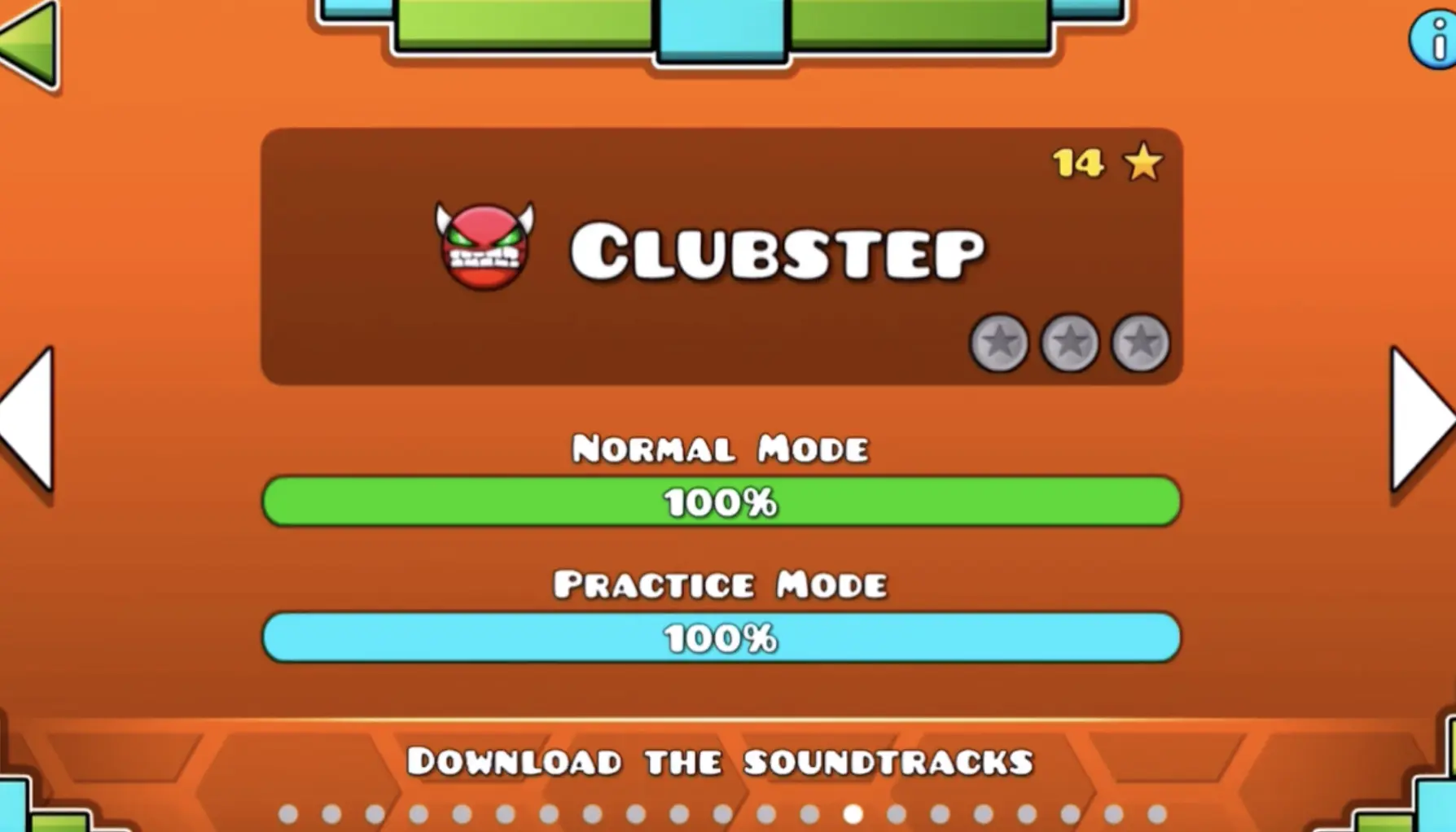
Clubstep is the first real official Demon graduation test. Tight Ship, fake routes, pressure, and multi-skill control all collide here. If you beat Clubstep cleanly, your fundamentals are no longer beginner-level.
The First Real Milestones
When are you no longer a complete beginner?
A strong milestone is beating Can't Let Go. If you can get through its upside-down and darker pressure sections, you are no longer playing on pure reaction alone. You are starting to use rhythm and control.
What is the first real wall?
For many players, it is Time Machine. Triple spikes destroy sloppy timing and expose fear immediately. It is usually the first official level that feels unfair until your consistency catches up.
When should you start using Practice Mode seriously?
Clutterfunk is the clearest answer. Once you reach this level, trying to brute-force every attempt from 0% becomes much less effective. This is where targeted section practice starts becoming the smarter path.
When are you ready to think about demons?
The clearest community-style milestone is beating Electrodynamix. Its speed pressure and Ship difficulty are enough to prove whether your nerves, timing, and reading have reached the level needed to start the Demon path seriously.
Which Official Levels Not to Touch Too Early
Electrodynamix
Do not assume its position in the official list means it is a normal next level after Theory of Everything. Its speed pressure can absolutely shatter a newer player's confidence. If it feels way too fast, that does not mean you are hopeless. It means the game finally hit you with true reaction compression.
Hexagon Force
If your rhythm and visual tracking are still weak, Hexagon Force can feel incomprehensible. Its dual sections are not just hard because they are fast. They are hard because they force your attention into two lanes at once.
Deadlocked
Do not touch Deadlocked first just because it looks cool. Of the official demons, it is the one most likely to humiliate an underprepared player immediately. Fast Wave pressure alone is enough to send many players straight back out.
The 2.2 / 2026 View on Official Progression
Visual reading matters more than old memorization habits
Modern Geometry Dash design teaches players to read through motion, effects, and visual noise. That matters because newer official and community content expects you to look at terrain relationships, not just stare at your icon.
Device myths matter less than they used to
In the 2.2 era, official-level progression is much more about rhythm, timing, and muscle memory than hardware mythology. If you are stuck, the answer is almost never 'buy a better monitor first.' The answer is usually cleaner reads and cleaner reps.
Platformer is a parallel path, not a shortcut
The Tower and other Platformer content are useful, but they do not replace classic auto-scroller fundamentals. Beating platform-style stages will not automatically prepare you for Clubstep Ship control or Deadlocked Wave pressure. Treat them as a second lane, not a shortcut through the main one.
If You Are Playing Geometry Dash Lite
Geometry Dash Lite is still a perfectly valid starting point for the early official learning curve. It lets you build timing, rhythm, and pattern discipline before you worry about the full Demon route. If your goal is to become better at the game, Lite is not a waste of time. It is simply an earlier slice of the path.
Final Advice: Official Levels Are a Training Ladder, Not Just a Playlist
The best way to think about official Geometry Dash levels is not 'what comes next in the list?' but 'what skill am I supposed to be learning here?' Once you ask that question, the progression becomes much clearer.
Some levels are there to build trust in rhythm. Some are there to punish weak habits. Some are there to test whether you can stay calm under pressure. If you follow the official path with that mindset, you improve faster and tilt less.
FAQ
What is the correct order to play Geometry Dash official levels?
The official in-game order is the default route, but the smartest beginner path is to think in stages. Early levels build timing and gravity awareness, mid-game levels build memory and mode control, and later levels like Electrodynamix and Clubstep act as true skill gates.
Is Electrodynamix harder than Clubstep?
For many beginners, Electrodynamix can feel harder at first because its 3x-speed Ship pressure arrives before you are mentally ready for it. Clubstep is still the bigger overall exam, but Electrodynamix often feels like the sharper immediate shock.
Why is Can't Let Go so hard for beginners?
Because it pushes beginners out of pure reaction play. The level introduces upside-down logic and sections where rhythm trust matters more than simply reacting to what is directly in front of you.
How do I get past the Time Machine triple spikes?
Time Machine's triple spikes are mostly a consistency problem. The best fix is to stop rushing the input, keep a stable jump rhythm, and practice the pattern until it feels predictable instead of scary.
When should I start using Practice Mode in Geometry Dash?
A very strong point to start using Practice Mode seriously is Clutterfunk. From there on, trying to brute-force every level from 0% becomes much less efficient than isolating difficult sections and learning them directly.
Should I play Clubstep, Theory of Everything 2, or Deadlocked first?
Clubstep should usually come first. It is the most natural first official Demon because it teaches the broadest set of core pressure skills without throwing you into Deadlocked's faster Wave demands too early.
How do I practice the dual mode in Hexagon Force?
The key is to stop trying to follow only one icon. Practice by focusing on the overall rhythm and lane relationship first, then use repeated attempts to make the asymmetry feel familiar instead of chaotic.
What is the best official level to practice fast Ship in Geometry Dash?
Electrodynamix is one of the best official levels for high-speed Ship training because it compresses your reaction window and forces you to stay controlled under real visual pressure.