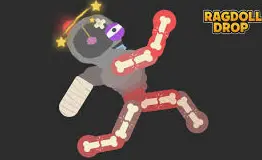
The first few seconds tell you exactly what kind of mess you signed up for: line up a floppy little body, send it flying, and watch physics do something rude. One run might bounce your ragdoll off a wall like wet laundry, the next might dump it into a deep pit, strap it to something ridiculous, or fire it across the screen just to see which limb complains first. The fun is not in graceful control; it is in nudging chaos in the right direction and then enjoying the aftermath when the engine decides to get creative.
What keeps Ragdoll Drop sticky is how many little bad ideas it lets you turn into progress. Vehicles, launch tools, and impact-heavy setups change the flavor of every attempt, while challenge goals keep you from treating every run like the exact same face-plant. There is a nice trashy elegance to it: chase bigger wrecks, squeeze extra value out of collisions, collect resources, unlock more nonsense, repeat. It also helps that the whole thing suits short play sessions perfectly, because you can cause a shocking amount of damage before your coffee even cools down.
actionInstant play
💡
Editor's Note:It feels like a crash test dummy got handed a theme park budget and absolutely no adult supervision.
Playing: Ragdoll Drop
How to play
Controls
Use your mouse or touch input to aim launches, trigger props, and send the ragdoll into the part of the level that looks most likely to end badly.
Adjust your release timing and launch angle instead of just spamming attempts; small changes in setup can turn a weak flop into a glorious chain of impacts.
Core rules
Damage comes from how the ragdoll hits, tumbles, rebounds, and interacts with hazards, so the best runs usually create multiple impacts instead of one big thud.
Progress is driven by completing challenge-style objectives and collecting resources, which means the smartest launch is not always the funniest one on the first bounce.
Goal
Cause as much effective destruction as possible while using each setup, hazard, and vehicle cleverly enough to clear challenges and unlock more toys.
Tips & tricks
Your first launch should buy information, not glory
Early attempts are better spent learning how a pit, wall, rail, or vehicle actually feeds momentum than chasing a miracle crash right away. Send the ragdoll on a cleaner test line first, watch where the second and third impacts happen, then start pushing the angle harder once you know which part of the setup is doing the real work.
When a cart or launcher is involved, milk the ride before the slam
The obvious mistake is focusing only on the final collision. In Ragdoll Drop, the trip into the crash can be just as valuable if it keeps the body unstable, twisted, and ready to pinball into something else. A better setup often comes from using the vehicle or prop to create ugly body positioning before the main hit lands.
Mission progress loves ugly combo routes
If a challenge wants big damage or better efficiency, stop thinking in single impacts. Aim for routes where the ragdoll clips one surface, rolls into another, then gets finished off by a drop or obstacle. Those chained wrecks usually pay out better than one dramatic launch that burns all its momentum too early.
Resource farming gets better when you stop chasing perfect chaos
Once you are replaying stages for unlocks, consistency starts beating spectacle. Find a setup that reliably produces several medium-value collisions in a row and repeat it until the resources stack up. The funniest launch is not always the most profitable one, and the game quietly rewards repeatable destruction more than random fireworks.
Why it’s fun
Every attempt turns basic slapstick into a little physics experiment, and the best crashes have that lovely split-second where you realize the ragdoll is about to hit three terrible things in a row.
It is built for quick stress relief: short runs, fast resets, ridiculous impacts, and just enough progression to keep one more launch feeling justified.
FAQ
Can I play Ragdoll Drop for free?
Yes. Ragdoll Drop is positioned as a free-play physics destruction game, and its appeal comes from quick runs you can jump into without treating it like a huge time commitment.
What kind of game is Ragdoll Drop?
It is a casual ragdoll physics sandbox with challenge progression. You launch a floppy character into hazards, walls, pits, and absurd contraptions, then try to turn the resulting chaos into bigger damage and better rewards.
Why do my launches in Ragdoll Drop feel weak?
Usually because the setup only creates one clean impact. Stronger runs come from awkward body angles, secondary rebounds, and routes that keep the ragdoll colliding with multiple surfaces instead of stopping after the first hit.
Is Ragdoll Drop just random, or is there actual strategy?
There is plenty of chaos, but it is not pure luck. The strategy comes from choosing angles, timing releases, using props well, and learning which stage elements turn one hit into a messy damage chain.
How do you progress faster in Ragdoll Drop?
Focus on challenge completion and reliable resource farming instead of only hunting the most dramatic crash. A repeatable setup that produces several solid impacts often advances you faster than a single flashy launch that barely pays out.
What makes Ragdoll Drop worth replaying?
The unpredictable physics do a lot of the heavy lifting, but the replay value really comes from mixing different props, vehicles, and launch styles while chasing better destruction, more resources, and unlockable extras like hidden skins.